From the Field

Canker Removal Now is Critical for Fire Blight Management this Year
Tuesday Aug 25, 2026
No one wants fire blight in their orchard next year. For fire blight to take off in your orchard next year three things need to be there: the pathogen, the warm conditions and...

Storage Scald of Apples
Saturday Aug 15, 2026
The appearance of storage scald has been related to orchard temperature during the final weeks of fruit maturation. DAS provides accumulated hours below 50°F as well as orchard management recommendations for this postharvest disorder.

Predicting Third Generation of CM
Saturday Aug 01, 2026
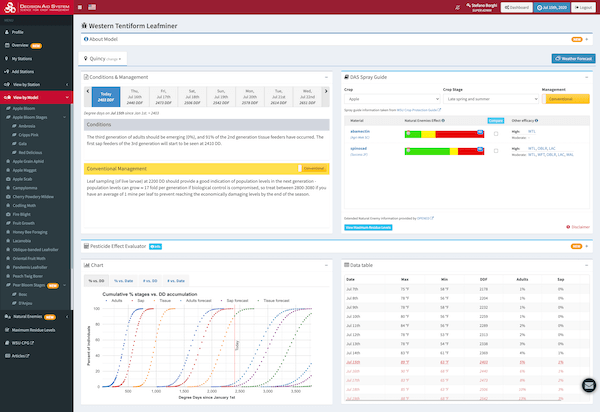
Predicting the extent of the third generation of codling moth (CM) is based on a statistical relationship of the degree-days historically found on 1 August and at the end of the season on 1 November. We update this prediction roughly every 10 days after 15 August because the DD prediction for 1 November gets more accurate as we get closer.
What is DAS?
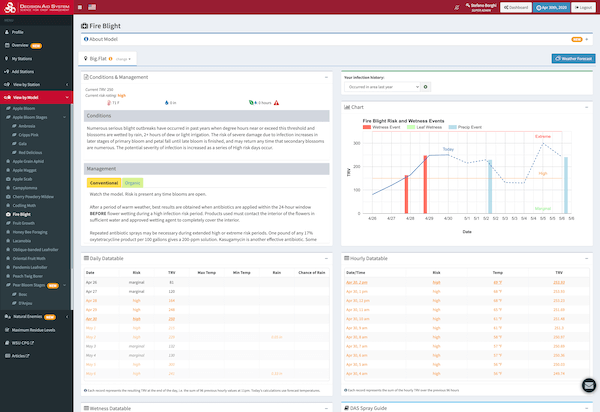
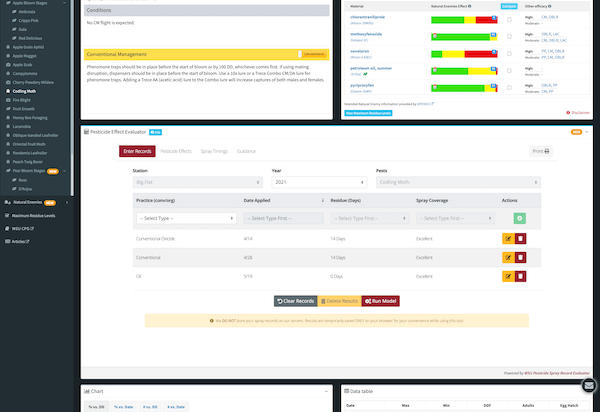
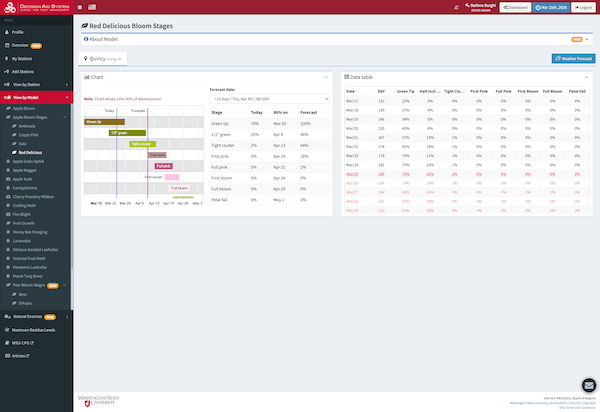
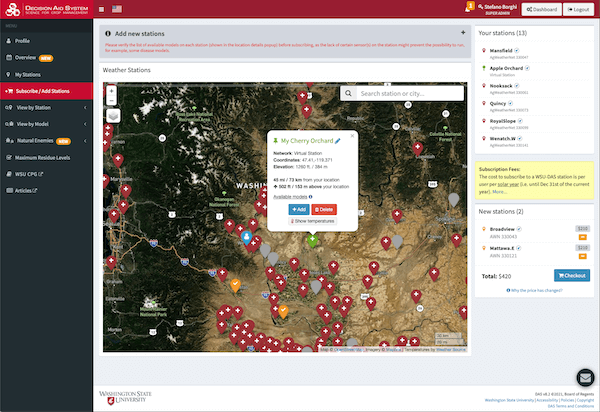
The Decision Aid System (DAS) is a collaborative project between WSU Extension, the WSU Agricultural Research Center, and partners in agricultural industries. The DAS is a web-based platform designed to transfer time-sensitive information to decision makers. We run insect, disease, disorder, and horticultural models to predict on-farm conditions in real time, and link these site-specific forecasts to appropriate management and pesticide guidelines.